

MEDAR
UX Design for a Statewide Reporting Platform
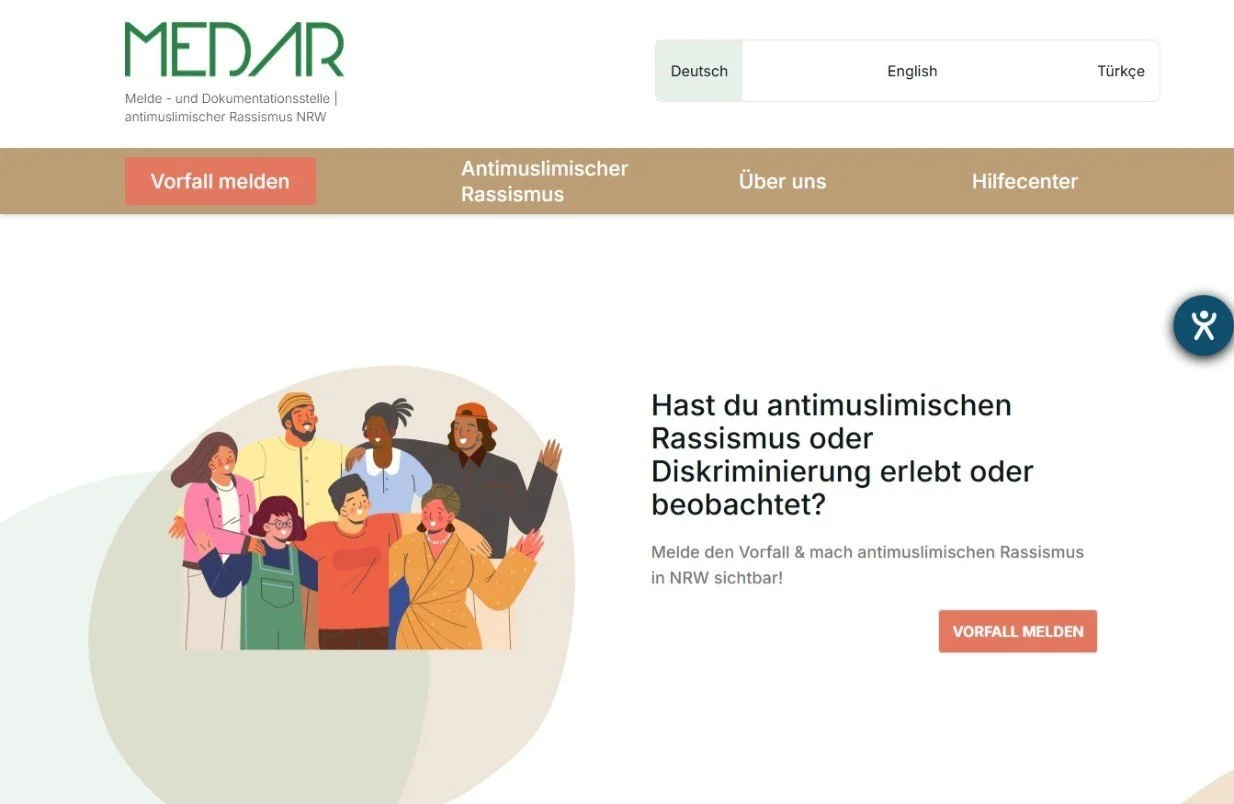
A digital platform designed to combine security, trust and accessibility.
For the statewide reporting office MEDAR, I developed a UX concept that enables people affected by discrimination to document incidents safely, anonymously and with low barriers.
The platform supports both personal reporting and the systematic documentation of discrimination cases across the
Project Facts: MEDAR UX Design
Project: MEDAR – Reporting and Documentation Office for Anti-Muslim Racism in North Rhine-Westphalia

Outcome: Live platform for the statewide documentation of discrimination cases
Role: UX concept, interface design, user navigation
Client: Interkultur e.V. and Coach e.V., network partners in NRW
Focus: Low-barrier reporting, data protection, accessibility
Concept
Together with Interkultur e.V. and Coach e.V., a digital reporting platform for anti-Muslim racism was developed as part of a statewide initiative.
The goal was to create a platform where affected individuals and witnesses can report incidents of discrimination safely, anonymously and with minimal barriers.
At the same time, the system needed to generate structured data for documentation, statistical evaluation and advocacy work.
The design therefore had to balance two essential aspects: building trust while also acknowledging the emotional reality of users reporting sensitive experiences.

Footer Section Desktop Home Page
“Meriem quickly grasped the project’s complex requirements and translated them into clear, user-centered solutions. With her calm and professional approach, as well as her flexibility throughout numerous iterations, she played a key role in building trust within the team and successfully advancing the project.”
Bareen Wahed, Project Officer MEDAR, Coach e.V.
Challenges
Special Features &
Data protection and security
Protecting those submitting reports was the highest priority. Every design decision had to consider the sensitive handling of personal data.
Trust and sensitivity
The platform needed to communicate reliability, seriousness and respectful language.
Complex stakeholder structure
Ministries, NGOs and development teams contributed different requirements that had to be translated into one coherent system.
Accessibility
Clear language, strong readability and multilingual access points were essential to ensure accessibility for a wide range of users.
UX concept and interface design as the sole designer
Analysis of existing reporting systems and user needs
Development of wireframes, prototypes and responsive designs
Iterative testing with the project team and user groups
Close collaboration with developers to implement sensitive data protection requirements
Process

Referral-Section, Desktop
The final product is a low-barrier and intuitive reporting platform that enables anonymous and secure submissions while providing clear guidance even in emotionally difficult situations.
The platform is now live and contributes to the statewide documentation of anti-Muslim discrimination cases.
Outcome
Learnings
& Impact
This project demonstrated the importance of iterative collaboration with stakeholders, particularly when addressing sensitive societal issues.
It strengthened my ability to translate complex legal and political requirements into functional and accessible interfaces.
Above all, it reinforced the understanding that UX is more than visual design.
It can create spaces where people find safety, trust and meaningful ways to take action.